

Kira Nerys: A Character Study
And a lesson in how to write strong female characters.

Hello again, or welcome, if it's your first time here.
I've recently been listening to a large amount of Star Trek-themed podcasts and web-based shows (thank you YouTube algorithm) and it's allowed me to reflect quite a bit on my childhood love of the property that still has a special place in my heart. Specifically the best of all the series, Deep Space Nine.

Breaking the mold of Star Trek by setting the show on a space station as opposed to a starship “trekking” through the cosmos to “seek out new life”, upset quite a few of the more puritan fans. For the very reason it upset them, it intrigued me. From the very beginning, I was on board with this new journey “beyond the final frontier".
Planting the crew on a station allowed for two interesting developments for the show, the first being a bevy of supporting and recurring cast members, some of which were more interesting than the main cast. The second, (once a certain someone got out of the way) was an experiment in serialization (something else the puritans didn't like) that allowed for long-form storytelling and a level of character development unprecedented for the property.
But this isn't about the show and my love for it, this is about one of the staples that held the show together, and quite possibly one of the best characters in all of Star Trek, Kira Nerys.
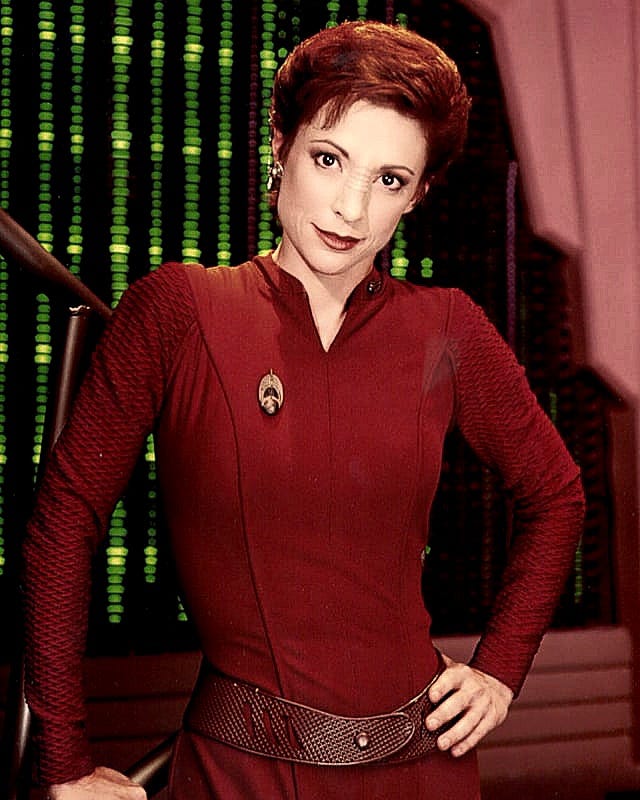
But to understand Kira and the work done by the writers/showrunners to bring her to life, you must understand her roots.
The Backstory
For the better part of a century, her homeworld of Bajor was occupied by a militant neighboring species known as the Cardassians. This is a core element of the show, as the entire reason for the Federation (intergalactic good guys) to establish a presence in Bajoran space is to assist them in rebuilding their society after the withdrawal of the occupying force.
The Cardassians themselves are a hardened people, on the brink of collapse until their military took over the government and, in a very Weimar Republic sort of way, instituted “order” and “efficiency”. The military took the Cardassian people from starvation to surplus and then focused their efforts outward, because, what sort of military dictatorship doesn't move toward conquest?
While occupying Bajor, the Cardassians subjected the native population to forced labor camps, often working the laborers to death, while rationing out miniscule portions of food, utilizing “comfort women", and strip-mining the planet of its resources. During the fifty-year occupation, there were entire generations born into veritable slavery that knew nothing of freedom or the peaceful lives their ancestors once lived as a highly spiritual and artistic people.
Kira Nerys was born during the occupation, started fighting at twelve years old, and by the age of thirteen was recruited into a resistance cell (or terrorist cell, from a Cardassian point of view) where she spent half her life fighting and killing in the dirt to free her people. Losing her family and many friends in the process, her life was one devoid of luxuries (or necessities) and filled with hardship.
Sidebar
For anyone unfamiliar with Star Trek, this exploration of darker themes is a massive departure from the near-utopian future presented to us in the initial vision of Star Trek's creator, Gene Roddenberry. It also provides us a glimpse of the galaxy outside the comforts of the Federation, something remarked on by the Starfleet characters of the show more than once. And one more thing for the puritanical fans to be upset about.
The Journey
When we first meet Kira, she is very much full of anger, hatred, and mistrust. She makes snide comments towards the Federation officers, lashes out at government officials, and makes no apologies for it. Unlike the modern girl-boss archetype, it does get her in a fair amount of trouble as the series progresses, and this is a recognized flaw that she works on, along with the rest of her damage.
I know she sounds like a real hoot to work with, Bajoran women have a bit of a reputation of being… fiery. But there's a reason she's in the position she's in, as is proved in the very first episode where, in an act of unmitigated gall, she challenges three Cardassian warships with nothing but six torpedoes and one hell of a poker face. Because she knew there was no hope in winning through force, she banked on being able to bluff her way through the confrontation and buy enough time for a more peaceful resolution. It paid off. To be fair, of course it would, what kind of show would it be if the place it was named for, blew up in the first episode? Still, within the confines of the universe, it was impressive, albeit, unorthodox.
One of the major impacts on her early on is an encounter with the spiritual leader of her people in the episode “Battle Lines". When Opaka, the aforementioned leader, notices Kira's unbridled rage at a war that is not hers, she pulls Kira aside for what amounts to a cleansing, confession, and therapy session all in one. This allows her a moment of release where for the first time in her life she is allowed to let go of the anger and pain she has carried for so long. It's a cathartic moment that pushes her further away from her past and you can see her rough exterior begin to soften from this point forward.
Next, in the aptly named “Progress", Kira is forced to acknowledge that her days of fighting for, and as, the underdog, are over. She is no longer a freedom fighter but rather an administrator and needs to deal with the new set of challenges her position entails. In this case, it's removing a fellow underdog from a moon that the government plans on converting into a giant battery (it's more complicated than that, but… technobabble). She doesn't want to do it, she likes the old coot, he's awfully charming, (despite clearly being a windbag) but she has a job to do. There is no way around it, no deus ex machina, no happy middle-ground. She has to make the tough call in the end because she's not a rebel anymore.
In the episode entitled “Duet", one of the best of the entire series, she comes face-to-face with her blind hatred of Cardassians. A Cardassian male visits the station with a very specific illness that could have only been contracted from the most infamous labor camp on Bajor, (you can think of it as an allegory for Auschwitz, to put it into real-world context). From the moment she sees him, there is contempt in her eyes and she has him immediately arrested. What proceeds is a very cat-and-mouse-style series of interactions between him and a determined Kira. He denies being at the labor camp, then admits it, but claims to have been nothing but a file clerk. When he is visually confirmed to actually be the overseer of the camp, Kira is adamant about putting him on trial for war crimes. Until it is revealed that the overseer had died years before. The Cardassian that was arrested had been the file clerk all along. He had undergone surgical procedures to make himself look like the overseer and intentionally went to Bajoran space to sacrifice himself for the sins of his people so that both Bajor and Cardassia could begin to heal. Kira is so moved by his motivations she releases him from custody and expresses a deep sadness when he is killed by a fellow Bajoran just for being Cardassian. She realizes that being Cardassian isn't enough of a reason to hate, and takes a step towards healing herself. I'm including a YouTube playlist for this one because the performance by Harris Yulin as the Cardassian is masterful and regardless of my spoiler-filled summary, it is well worth the watch. (I would have embedded it, but for some reason, it’s not cooperating, apologies)
There's not much that happens in the second season that directly furthers Kira's development. But we are given a glimpse into her much hinted-at past. Though it is through the eyes of another character, it shows us some of the “red in her ledger”: the killing of a Bajoran collaborator. This doesn't sound too bad of a thing for her to feel guilty about, after all, collaborators are the worst kind of war criminals, but we are reminded that there's a lot she had to do that she wasn't proud of, and her past does eventually catch up with her…
During the third season, in “Second Skin”, she is abducted and surgically altered to look like a Cardassian because of a passing resemblance to the daughter of a very influential high-ranking member of the Cardassian military. The attempt is made to make her believe that she is a sleeper agent, and a daughter of Cardassia. This is an elaborate ruse to make her “father" reveal his allegiance to a dissident movement within the Cardassian government. This incident isn't as pivotal to her development as other Kira-centric episodes, but there is still a lasting effect we get to see in a later season.
But before that, Kira is reunited with Shakaar, the leader of her former resistance cell, in the aptly named episode… “Shakaar". In fact, she is reunited with several members of her cell and we get more information about her past that is ever-looming behind her. As she and her former colleagues fight the government for fair use of some much needed machinery, they fall back into their old ways and end up preventing the totalitarian take over of their people by a rather devious person in power. (She really is a character after my own libertarian heart).
Before her past catches up with her, in the fourth season episode “Indiscretion”, Kira is on the hunt for a crashed Cardassian prisoner transport that had a close friend of hers on board. With a good lead in hand, she intends to pursue it until the Cardassian government insists on sending a representative along with her, none other than the former prefect of Terok Nor (the name of DS9 under the Cardassians). Though initially opposed to the idea, for obvious reasons, she relents and reluctantly departs with Gul Dukat accompanying her. The tension between them is so thick it’s almost palpable and it isn’t until they reach the planet that they connect on a personal level. Kira and we the viewers begin to see Dukat’s, for lack of a better term, humanity. Until his ulterior motives are revealed when they discover the downed ship and a mass grave: his Bajoran mistress was on the transport (but did not survive the crash), along with his illegitimate daughter, whom he plans to kill (Cardassians have a well-deserved reputation for being cold-hearted and the concept of family is at the center of their culture, so you can imagine the problem an illegitimate daughter would cause someone in a high-ranking position). Kira vows to stop him. When the truth of the missing transport is revealed, that it had been shot down with both its crew and passengers subject to slave labor by a hostile race, Kira and Dukat work together to free the captive Bajorans and Cardassians alike. Kira’s friend had died in the years previous, but they do find Dukat’s daughter. After a tense moment of who’s going to shoot first, Dukat relents and agrees to take his daughter home, consequences be damned.
A mere nine episodes later, in “Return to Grace”, Dukat returns. No longer in the prestigious position of authority he once was, and now without a family due to the revelation of his daughter, he is but a lowly freighter captain and Kira is once again forced to deal with him as he has been tasked to escort her to a conference in Cardassian space. Kira is reunited with Tora Ziyal, Dukat's half-bajoran daughter, and we are introduced to Damar, Dukat's right hand. Because this is Star Trek, nothing goes smoothly, the conference is attacked and Kira is forced to work with Dukat, relying on her past skills to teach the former military leader how to fight like a terrorist. Eventually, after taking revenge on the attackers, Kira convinces Dukat to let her take Ziyal with her to DS9, for her safety, and she takes on a big sister role with the daughter of someone she once considered a mortal enemy.
The fifth season episode “The Darkness and the Light", another high-point of the series, gives us a very up-close look at not just the red in Kira's ledger, but the fallout from it when her past catches up with her, full force. Members of her resistance cell are being killed off in very vicious and one might even say, creative, ways. Even after determining that the killings are tied to Kira and knowing who will be next proves futile as someone has gone through great lengths to eliminate these people, seemingly with all manner of contingencies in place. Kira, being the spitfire she is, refuses to sit back and wait for death to come to her, or anyone else she knows. Despite being pregnant (don't ask, it's complicated and not really relevant here, though it does cause some measure of humor during the course of her pregnancy… not in this episode though… where was I…) Right, despite being pregnant, Kira goes off on her own, tracks down, and is captured by, the murderer: a disfigured, both physically and mentally, Cardassian that had been the victim of a bombing carried out by Kira and her cell. Despite the target of the bombing being a military leader who was not unlike Amon Göth, there were numerous civilian casualties, including children and her captor, who was little more than a butler. There's a conversation between Kira and her would-be killer that amounts to a competition of which one of them has the moral high ground. Though Kira is initially staunch in the justification for her actions, by the end of the episode she is left in a state of what could only be called mourning, after she manages to kill her captor. This episode presents the concept of freedom fighters, or more accurately, terrorists, in a very gray area, firmly between the darkness and the light (see what they did there?). Kira isn't proud of her actions during the occupation, and her would-be murderer is not necessarily wrong in his condemnation of her indiscriminate attacks, but war is an ugly thing, and true oppression, like murdering innocent Bajorans for not flying the Cardassian flag, as Kira's target did, demands retribution, as it was said in another show that aired around the same time: “…blood calls out for blood.”
Nothing to do with Kira directly, Gul Dukat, in his pursuit of power and his desire to restore the Cardassian Empire to its once-great status, conducts secret negotians with The Dominion, one of the greatest threats the Federation has ever faced. Installing himself as the military leader of Cardassia, thanks to his Dominion allies, Dukat becomes one of the most dangerous people in the galaxy, a topic for another day.
In “Ties of Blood and Water”, the Cardassian from “Second Skin" that Kira had been abducted to expose as a traitor to the government, visits DS9. It is revealed that not only has she remained in touch with him, but they have developed a surrogate father/daughter relationship, something she never could have done a few years earlier and likely never would have happened had she not had the encounter with the file clerk and learned to see her former enemies as individuals.
By season six, the Dominion invasion of the Alpha Quadrant is in full-swing and Bajor is, for all intents and purposes, abandoned by the Federation. Kira remains at her post on Deep Space Nine as Bajoran Liaison Officer, but now reports to Dominion representatives and their Cardassian allies. It doesn't take long for her to return to her roots as a born rebel and she establishes a new resistance cell to make life difficult for the Dominion and assist her friends in the Federation when the time is right. A little bit of irony considering she initially didn't want the Federation anywhere near Bajor. She clashes with Damar, who is struggling with alcoholism, fends off romantic advances from Dukat, and somehow manages to keep her little resistance cell (that doesn't have one iota of combat experience) from dying. But not all of them. Tora Ziyal is murdered by Damar in a shocking moment that makes Dukat lose all semblance of sanity, and somehow accelerates Damar's career to taking the place of Dukat as leader of Cardassia.
Her experience with being a terrorist (let's not beat around the bush any longer, she certainly didn't, and neither did the writers) came in handy again by halfway through season seven. The alliance between the Dominion and Cardassians was falling apart, largely because Damar was unable to keep the Dominion in line and he ends up defecting, creating his own resistance cell. In the ultimate form of irony, Kira was tasked with entering enemy territory and teaching the very people she fought against for so long how to fight like terrorists. Including the man who killed her adopted sister. Despite some initial interpersonal rough patches, (which were absolutely to be expected) at this point in her life, Kira is able to empathize with her former enemies, including Damar. By the end of the war, she is instrumental in liberating the Cardassian people from their oppressors.
The Wrap-Up
Throughout the show, we watch Kira go from a hardened and damaged woman who keeps everyone at arms-length to someone capable of love and understanding, even for people she hated. Initially being fueled by nothing but vitriolic hate, by the end of the show she possesses what one could call serenity, or a quiet wisdom. All the while, there is a subtle change in her appearance as she moves away from the demands of being a terrorist and embraces both her new role and her femininity without losing any of her strength as an individual. Going from this:
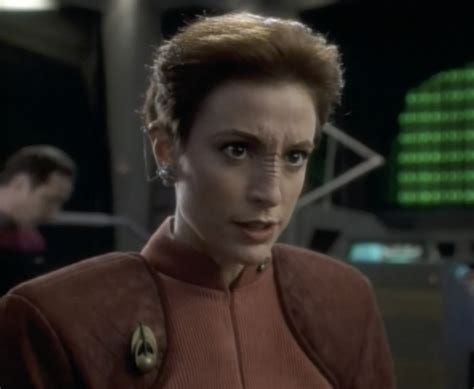
To this:

This is the kind of skilled character writing that inspires me. In fact, I'm going to make a bold claim here… If you want to write a “strong female character" then Kira Nerys is the case study. A proper character arc where someone has a solid backstory, goes through trials & tribulations, and experiences growth as a result. Knowing they have baggage and seeing them work through it instead of reveling in their damage as is so common nowadays in fiction. You can't ask for more.
Full disclosure, my recent article about Battlestar Galactica and the abysmal characters presented to us the viewers also helped to inspire this breakdown. I was particularly disgusted with Kara Thrace, the girl boss with all the charm of what some would call a “toxic male". Kira Nerys is everything Thrace is not: a complex, well-developed, well-rounded character who is capable of growth and exhibits strength as an individual and as a woman. It's like comparing Wonder Woman to Captain Marvel, which, if you know anything about those comic book characters, there is no comparison. If you don't, well, just trust me, there's definitely a parallel.
Deep Space Nine gave us very complicated stories that forced us to reflect upon concepts that weren't always easy to think about. And the writers gave us incredible characters to explore these concepts through. Even if you're not a fan of Star Trek, it's worth watching because it takes the unbiased writing of previous series and layers it with a level of maturity and complexity that was rare to see back then. It's also almost nonexistent today.
This was fun to write, and a much more positive tone than my last couple of articles. I think I'll turn this into something of a series, and I know exactly who's next…
I enjoyed remembering all these cool stories from DS9. Man, Second Skin really shows how cruel the Cardassians can be. Can you imagine the depth of that deception? It's profoundly evil what they do to people. Only Miles got put through worse I'd say.
One thing that is unique about Nerys is her faith. Trek up to that point dealt with faith in a condescending manner. The stories involving characters of faith virtually always were told from the perspective that the faithful were primitive beings. But DS9 used characters of faith to challenge the rationalists (Starfleet/the Federation).
Faith is key to Nerys' character I think.
I look forward to reading every instalment of this series. DS9 is my favourite trek and I believe it represents peak Trek. Quark is my favourite character.